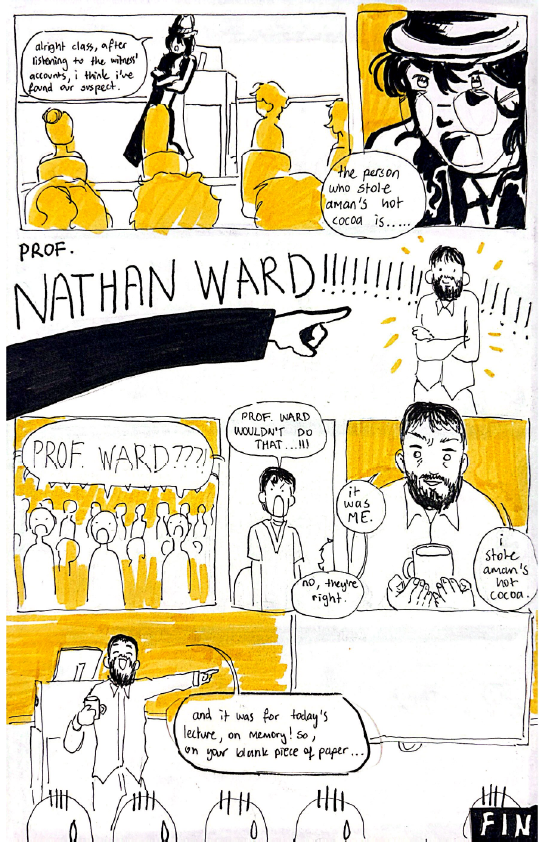
Cocoa Conundrum – 4 page comic
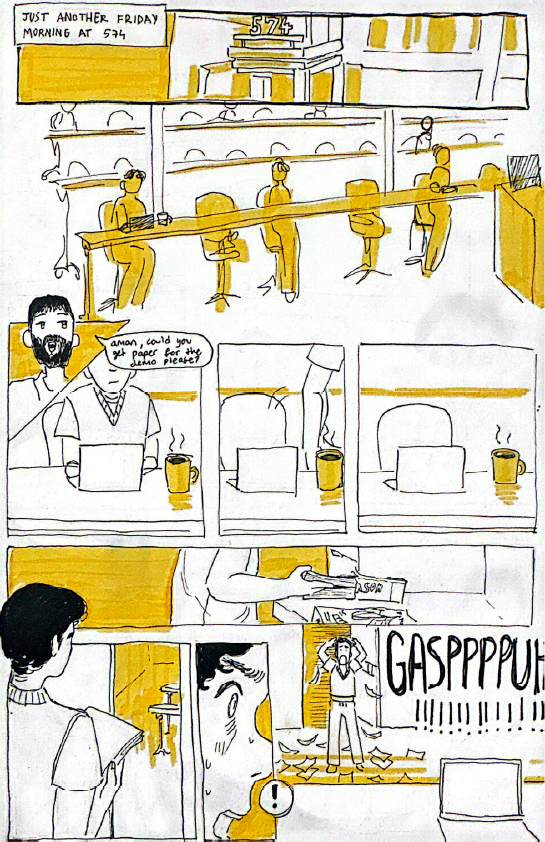
Cocoa Conundrum is a 4 page comic about the memory units in our engineering psychology class. The reason why I wanted to make this comic is because I wanted to combine what I learn in this class with my other degree, to see how using art can elevate engineering psychology content.
read more…
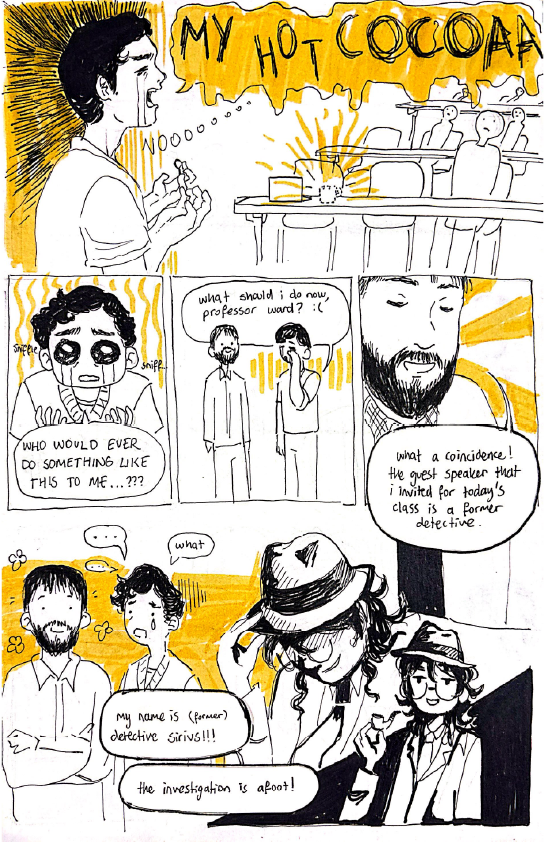
The comic takes place in our classroom, and follows the crime of our TA Aman’s hot cocoa getting stolen.
It also made me think about how information can be manipulated based on how it’s presented to the audience.
While reading, the audience is too caught up in the story and can only process how the information is given to them, and might not notice the less obvious clues. The way I decided to do that is by having Prof. Ward hold the cup of hot cocoa in his hands on the third page on the second panel.
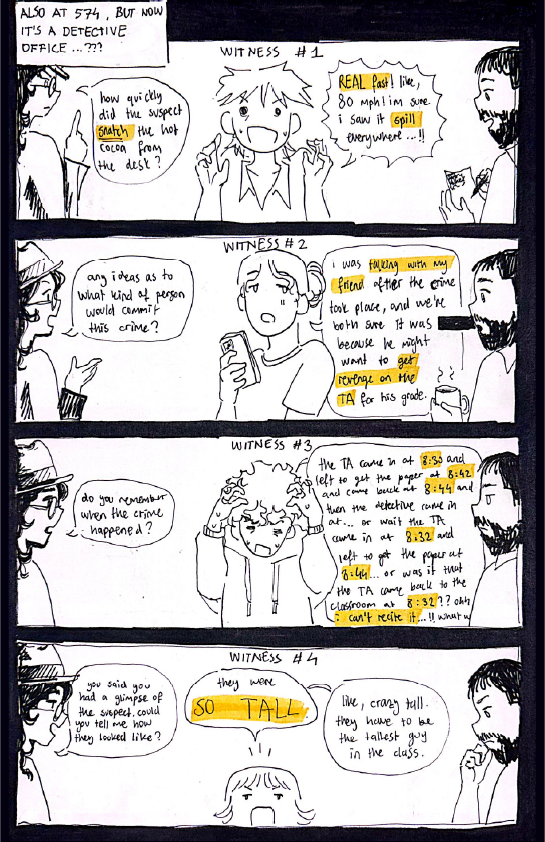
Another way I incorporated the class material into the comic is on the third page, where the witnesses give their accounts. The first witness is exaggerating their memories based on the detective’s question’s wording. This example is just like how witnesses give higher speed estimates when asked “how fast did the cars smash into each other?” compared to “how fast did the cars touch each other?”.
The second witness is a victim of confirmation bias, by assuming who the suspect is based on what they think their motivations might be. Another reason why their memory is not correct is because their memory got contaminated when they talked to their friend about the case.
The third witness is having trouble recalling the time the crime occurred, because they are overworking their working memory.
The fourth witness is calling the suspect “crazy tall”, which might be true, but I don’t remember Prof. Ward’s height. Just like the witness, I am pretty short and I would also call him “crazy tall”! However, this is very subjective and doesn’t mean anything for his height.
Lastly, when Aman says “Prof. Ward wouldn’t do that…!!!”, they exhibit cognitive bias based on their emotions.
This was a great experiment for me to see how well I can utilize what we learnt in class and imitate it just like in the amazing demos we see. I would love to try and do something like this again. Thank you Prof. Nathan Ward and Aman Shah for being a part of my story!
TEAth (Toothbrush & Encouraging Application) Project
TEAth is a prototype for a project that I worked on alongside my classmate, Esra Ekmekçi. We did research, conducted a survey, designed a CAD model and an app interface based on our findings.
read more…
Our product TEAth is a Toothbrush & Encouraging Application for improving kids and teenagers dental hygiene habits. It consists of a specially designed toothbrush and application that can remind users to take care of their dental hygiene, encourage them to brush their teeth for longer and more effectively, and help track their progress.


Animations of Spencer (space + dancer) that play as you dance on the physical DDR pad
DDR on Touchdesigner with physical DDR pad
Using Touchdesigner, a digital art program, an Arduino UNO board, and materials to build a pad, I made my own version of the game Dance Dance Revolution.
read more…
Touchdesigner is a visual programming software where users can code various effects with nodes. For this project, I used Touchdesigner to recreate the interface of the DDR program and display the animations that correspond to the player’s movements on the physical pad.
For the physical pad, I used foam and aluminium foil to create a stepping pad, and used wires to connect that to the arduino board. Using the inputs from that arduino board, Touchdesigner can give feedback to the player if they dance correctly.
Special thanks to Andrew Hlynsky for helping me build this and providing supplies!